Both challengers have in common from the comics and have the same basic theme: the murder victims.
More precisely, it is Kurosagi Valter Dark dealing with "souls" of the murder victims who can not leave the body after death. Last
desires, positions left open, anger and disappointment, guilt. The desperate desire to continue living.
The reasons why a soul does not want to leave the body are many and that the agency is Valter Dark Kurosagi corpse delivery them solve their own way.
Small note on the challenge in place: I have too much stuff to read. This means that in the spirit Highlander, at the end of the challenge it will be only one "in the sense that I will devote my time and my monthly salary ... er ... the winner of the challenge.
Yeah.
Sad is not it? But
comics that you would like me to read from the queue and there are unfortunately forced to make some selection.
Here comes the challenge!
VALTER DARK

Texts: Alessandro Bilotta
Designers: Sergio Gerasi (No. 1), Andrea Del Campo (No. 2), Andrea Rossetto (n.3 ), Ivan Vitolo (No. 4)
Covers : Paolo Martinello
NOTE: Everything that follows relates to what I have read so far, that is until fourth number in the series. The characteristics of the comics I listed may change to continue the series.
in the right corner, weighing about seventy pounds of dark circles and several liters of alcohol in the body, we have the Spettinatone Italian, the Fury of the couch psychiatrist, Piacione Sentimental and misfortune, the defending champion: Valter Darkness!
Crowd applauds.
"Valter Dark faces the move!"
For those closely following this blog (ahaahahahha!), Walter will know that if the good has already gotten in a head-on collision against vampires and blond graduates ". Thus, the proudly belt encircles his sample covers.
We come to the point.
For the uninitiated, Valter Blind is an analyst of ghosts, restless spirits, which he calls the unconscious, which would leave this world, but for some reason can not. Valter
lives in Rome, in a kind of house boat on the Tiber, and to help us have a bona young secretary (but so far little used) and an old count in the bill, that Caesar Balestra, that when the creditors do not escape the medium .
In my previous post, I had enjoyed some quality comics as a good management of the characters and the possibility development of a fully open (at least that's the impression I got from the end of the first issue, at least puzzling) that could last throughout the whole of the twelve numbers making up the mini-series.
Good.
This did not happen.
The management of people has been good, especially in respect of that count Crossbow shoulder that has been transformed from a comic character real. Bilotta has been good to enrich it with a certain melancholy to the bottom, turning it into an old and gallant sentimentalist (especially in the third issue of the series).
In essence, Count Balestra is a bit 'gray.
In the first issue I noticed a certain irony in the character, in the long run has been replaced by just a couple of jokes or gags from time to time.
And this, unfortunately, was a bit 'the general trend of comics.
Valter Darkness (comics, not the character) is taken terribly seriously. This came out especially in the third and fourth issue of the series, where they were involved in terrorism and the old Italian 70.
be clear: to take seriously is not a defect.
The problem is that the premises posed with the first issue of the comic I had hoped for something different. Reading the various numbers of Valter dark I noticed a heavy background in some cases takes the form of stories, at least for me, I'm pretty boring and other tales in moralizing.
For myself, I feel a certain allergy to a certain kind of story, which I call the story "come here, grandfather tells you how the world works." Usually these stories end with a monologue that sums up the thoughts of the author or a striking fact that it fully endorses.
This is the case with the fourth issue of the series, called "our debtors."
The argument is interesting, although perhaps a little 'abused, and I must say that if Bilotta runs quite well. The problem is that it's all too easy.
Just as in the classic situation of "come here, grandfather tells you how the world", the point is that the speech Grandpa was right.
Doubts are kept to a minimum, the central point of history is not a question but an answer. And then in the end to his grandfather's eyes are bright and says "this is how the world works."
In fact about half of the story my grandmother arrived with the meat loaf and then cut short there. But as the week after you return home of their grandparents, never fear. It tells you
grandfather for the second time the same first half of the story.
Oh well, I digress.
However, the point of argument is that Dark Valter got sick of the annoying phenomenon of syndrome comics I've seen that recently engaged in Caravan, Michele Medda, but nevertheless, Unlike Medda, on the surface of discourse.
What's more, another heavy point down, reached the fourth issue still can not see an underlying structure that can keep up the mini-series. Currently there are only vague allusions to a possible hero's death by drowning.
So, from this point of view, the cartoon seemed very weak.
Quoting again the work of Medda, even here I found strong similarities with Caravan (which if you still have not grasped well, I found very disappointing).
Even here, in fact, a background story is the backdrop to a host of mini-side stories that, after all, are far from minor. In short, the main theme of the comic book fades into the background and becomes the excuse to tell stories that, in the end, there should not import anything. If
Valter Darkness was a comic serial to Dylan Dog, none of this would matter, but since this is a mini-series of twelve numbers, the main story should be ... that is, eccheccazzo, should be the main story!
I explained?
Finally, let me cite Stanis La Rochelle (if you have never seen Boris, DO IT!): This cartoon is too Italian.
Whether the lack of a narrative rhythm (often the stories are shipwrecked in boredom), and for the continued references to Italian culture that in the long run, they always seem more forced.
I understand that a comic strip set entirely in Rome, with Italian characters and all this presupposes that there has been a fundamental choice like "Ok! Talking about Italy," but that in each issue (in the second there's Carousel In the third several references to Italian cinema of the past, the terrorists in the fourth red) there should be elements to be recognized as a "typically Italian" is one thing that makes me turn up a little 'nose.
Apart from that all the various references that have been made so far are based on facts about thirty years ago, but if you keep screaming at each issue "Hey! But have you noticed that Valter Darkness is a comic strip all Italian?" not 're doing another show with pride that the mustache blacks and mandolin. And by the way blacks are the mustache and the mandolin than thirty years ago.
You can be Italian in 2010, without having the slightest idea what it is Carousel.
stories Valter Darkness (or rather, what I read) are almost all characterized by some great scenes in a position to immediately impress the reader.
For example:
! VALTER SPOILER FOR THE SECOND NUMBER OF DARKNESS!
The way Walter discovers his father's death, if it finds there, and suddenly realizes that he is a ghost.
! SPOILER END OF THE SECOND NUMBER VALTER DARK!
Beautiful scene.
But such scenes in Dark Valter there are different, the problem is that the sum of a few good scenes do not make a good comic.
The main defects in the script, in my opinion counts in two basic elements: a main story and the final out of focus too dull.
of the first aspect I have already spoken a few lines above.
As regards the second, the same defect in the first issue of Dark Valter has been replicated in subsequent issues, it's all too easy and fast. Valter
Blind is a psychiatrist of ghosts. A customer goes to his door, he gives him a little drawing, tell us a bit 'and * PUFF *, at some point the Unconscious is no longer bound to remain in the world of the living (generalization, I know, but I did not go too far from reality).
And this is repeated in the next issue.
's all too easy, do not you think?
"Ah, yes, I changed my mind. Now I am not afraid, I'm ready to go."
E 'a weak development. And unfortunately
is tied hand in glove with the very nature of the character of Walter. Being a psychiatrist does nothing more than "talk" to its customers (it is not my intention to belittle the profession, but in practice this is what is done).
And what's more, unlike the first issue, the action has been to decrease drastically. More and more talk, less action.
's all ... too little material.
Imagine a comic philosopher, a commitment to solve its huge mental puzzles and answer the big questions of life.
And 'certainly an ambitious idea, but I do not think a lot of fun.
Well, Valter Darkness is a comic strip about a psychiatrist who is a psychiatrist. The fact that his clients are dead is irrelevant.
But now, we are the challenger.
Kurosagi

Texts: Eiji Otsuka
Drawings: Housui Yamazaki
NOTE: everything that follows relates to what I have read so far, that is until third number in the series. The characteristics of the comics I listed may change to continue the series.
the left corner, directly from Japan, the land of almond eyes, the setting sun and several other western stereotypes, the idol of the bodies to pieces and sewn up, the champion of the dead evil Kurosagi!
Crowd applauds.
"Blava Kulosagi! You are thick!"
could say many things about the Japanese. You can hate them and you can love them, but surely we must recognize an incontrovertible fact: there should be tougher. In all that
do. In genre films, in-game show on television, in video games, movies, porn, and yes, even (perhaps especially) in the comics.
Officially, the company takes care of deliveries Kurosagi, but in fact its raison d'être is to fulfill (for a fee, when we can) the last wishes of the dead.
The Japanese are obsessed with death and the gods of death. In many comic books (three at random: Bleach, Death Note, Soul Eater), is the figure of the Shinigami, the reaper of souls, the God of Death. And even in this case there is something.
Kuro Karatsu is a shaman, is able to speak with the dead. But not only. Apparently it also able to animate them for a short period of time. And during these moments, a sort of Shinigami appears and puts his hand on his shoulder.
Kuro is the spearhead of Kurosagi team, led by a clever hacker named Ao Sasaki, a dowser can find corpses because of its pendulum (do not make stupid jokes) named Makoto Numata, a young stuffed Keiko Makino and a strange man named Yuji Yata always brings up a puppet who (he says) is animated by an alien entity.
Kurosagi The ramshackle group is the application of unconventional materials and underlying logic of a comic as Valter Blind.
Indeed, according to me, all that is missing its counterpart Italian: good stories sprinkled with various supernatural thriller (and I mean REALLY good with good stories, with exciting plot twists, a development capable of mounting suspense, beautiful original are able to whet the reader's attention, etc..) excellent graphics made a nice cut with horror and, above all, the ability to defuse an argument hard and painful as death.
The latter is, in my opinion, the main advantage of Kurosagi. It 'nice to read a comic book that talks about death, but he can do it with a certain irony without needing to be ridiculous. The dark humor is hard to use, it takes a certain ability to always remain in right field. And according to me, the manga by Otsuka and Yamazaki succeeds in full.
And while remaining essentially a comic entertainment, Kurosagi is also able to tackle difficult subjects such as suicide and revenge. It does so by moving the point of view in a new direction and original (more or less), plus a lively sauce of humor.
To me, this looks like so much.
are things that I do not think I've ever seen in Italy (perhaps a little 'Recchioni with his John Doe, I know very little, unfortunately), the country from which I think can come out now (almost) exclusively to stuff a huge weight, both in comics and cinema.
Unlike what was seen in comics by Bilotta, is not a psychological block to prevent the deaths to fly in heaven or somewhere, but the unexpressed desires, which vary from person to person.
Does anyone want to go home, another wants revenge, and another would just stand in a different place from where it was made. The task of Kurosagi is to fulfill these desires, which include all application materials, a something that can be seen and heard by the reader.
As this development is simpler than that of a Walter Dark?
And what is more exciting to watch Kurosagi the company that is anxious to trace a murderess rather than Valter darkness that resolves complex of inferiority of a teenager?
At this point, we come to the verdict of the judges (but now the winner of the challenge should be obvious).
AND THE WINNER IS ...
! Kurosagi!
The point of the speech is this: in a cartoon, I like to see people doing things.
And more and more things do these things and feel as the original "fun" (in the sense that they can stimulate, in any way, that part of my brain that makes me feel good), the more I'm glad to read a comic .
The premises of Darkness Valter were more than good, but in front of a main story drowning in subplots and the total lack of sense of humor, I found myself turning pages by force of inertia.
I'm really sorry, because after all I do not think that Valter Darkness is a bad comic.
But is it really too far away from those that are my favorites.
So goodbye Valter.
Good luck.
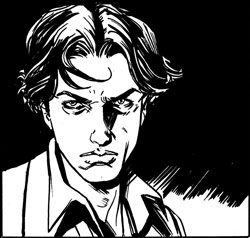
And come on, do not be angry.
PS I must say that I liked a lot of covers Paolo Martinello. Maybe a little 'too dark and dramatic, but still in line with the comics. It seems to me that the productions
Star Comics always have some great covers, but lost miserably for drawings (which seemed to me Valter Dark excellent in the first and fourth number is significantly lower in the second and third).


